

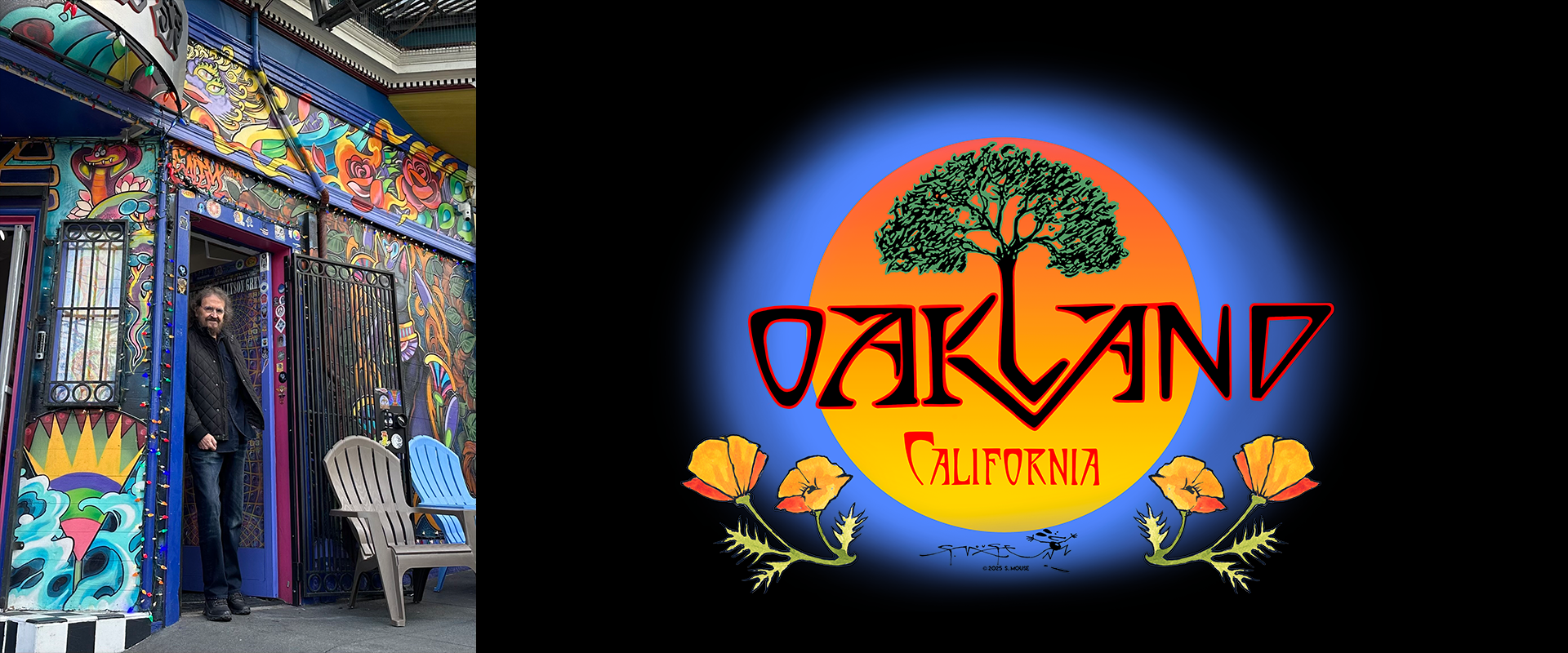
We are Oaklandish: Stanley Mouse
We're truly honored to announce our collaboration with the legendary artist Stanley Mouse. His remarkable works have transcended generations, and we are thrilled to be part of this journey through a t-shirt collaboration. Mouse’s work continues to influence artists today, showcasing his enduring legacy as a pioneer in graphic design and art.
Stanley's Bio:
Stanley Mouse is one of the most influential visual artists in rock history, creating images that became inseparable from the sound and spirit of a generation. Born in California in 1940 to a Disney animator father, Mouse grew up in Detroit, where Motown and hot rod culture shaped his artistic path. By thirteen, he was locally famous for his monster-driven muscle car drawings and custom pin-striping, earning his lifelong nickname in seventh grade.
After formal training at Detroit’s School for the Society of Arts and Crafts, he left to pursue rock poster art in 1960s San Francisco. There he met Alton Kelley, forming a legendary partnership that redefined concert poster design. Together they created enduring images such as the Grateful Dead’s Skeleton and Roses and adapted the iconic Zig-Zag figure—works that helped define the psychedelic art movement. Mouse and Kelley designed the first eight Grateful Dead album covers and later developed artwork that evolved into Journey’s Infinity, Escape, and Captured. His cover for Steve Miller Band’s Book of Dreams earned a Grammy Award in 1977.
Mouse’s client list reads like a history of rock: the Grateful Dead, Jefferson Airplane, Janis Joplin, Jimi Hendrix, The Beatles, Blind Faith, The Rolling Stones, and many others. His posters for the Fillmore and Avalon Ballroom became museum-collected symbols of the era. Exhibited internationally—from the Victoria and Albert Museum to the Louvre—his work bridges Art Nouveau elegance, American pop sensibility, and California counterculture. In later decades, Mouse expanded into classical oil painting while remaining a revered figure in hot rod art. Across monsters, chrome, skeletons, and luminous landscapes, Stanley Mouse’s career traces a singular visual journey through American music and culture.
When you begin a piece, do you start from memory, from research, or from a specific image that won’t leave you alone? Or in other words, do you feel like you’re inventing something new, or entering into a conversation with artists who came before you?
It comes to me through the cosmos, I channel it. Most the time it just appears with very little effort. Sometimes I look at reference material to get ideas but at this point I my life the reference material is mostly in my mind.
The 60s had Art Nouveau as a reference point. If you had to name the visual ancestor of this current era, who or what would it be?
Jose Guadalupe Posada, Basil Wolverton and Mad Magazine seem to be current pop culture influences. Alphons Mucha continues to be an influence in my art. I was honored to be included in a show of his work in Paris.
Your generation built an era around hand skill and analog craft. What do you make of tools that can generate images without the hand? Do you see AI as an extension of imagination, or as something fundamentally different from drawing?
Ai is not a positive tool for artists and art in general. Ai has a place where it can be used as a tool, but art is not one of them.
What does a normal hour in your studio actually look like? Is it quiet and meditative, or do you like noise around you?
I like drawing in cafes and places with a lot of energy. I enjoy painting at home while listening to music or painting in nature with one or two other artists. When I was young I would airbrush t-shirts at Hot Rod shows in front of hundreds of people, I loved the energy of the crowd. In the studio I usually have music playing and friends come in and out to visit throughout the day. The studio team is here prepping for art shows and fulfilling online orders. Recently I have been airbrushing.
Do you need new experiences to fuel your work, or does the act of drawing itself generate the energy?
Going places and having new experiences is definitely inspiring and necessary. It is good to get out and go to museums and galleries and see what other artists are doing. In the 60’s all the poster artists had a friendly competition. We were all influenced by each other and it created a movement. Art is a response to culture and without participating in that culture or having new experiences your art is not as full.
Drawing is physical, it demands the body. How has your relationship with your hands and eyes changed over time? What should younger artists understand about sustaining a drawing practice for decades?
Good posture and breathing are very important. When you get older your eyes do get weaker so take advantage of your young eyes. Exercise is essential for an artist because art is a sedentary practice.
***
Oakland is diverse and Oakland is proud. 'We Are Oaklandish' is a storytelling project created to highlight just that.
These are stories that shed light on the different experiences, memories, and opinions of the people in the city we all love. They are people who give our city its oddball spirit, its passion for justice, and its creative vigor. They lift us up with laughter, peace, nourishment, and authentic hard work.
They make us proud to call this town our home. They are Oaklandish.
Read more: We Are Oaklandish
Shop the collection: Hometown